
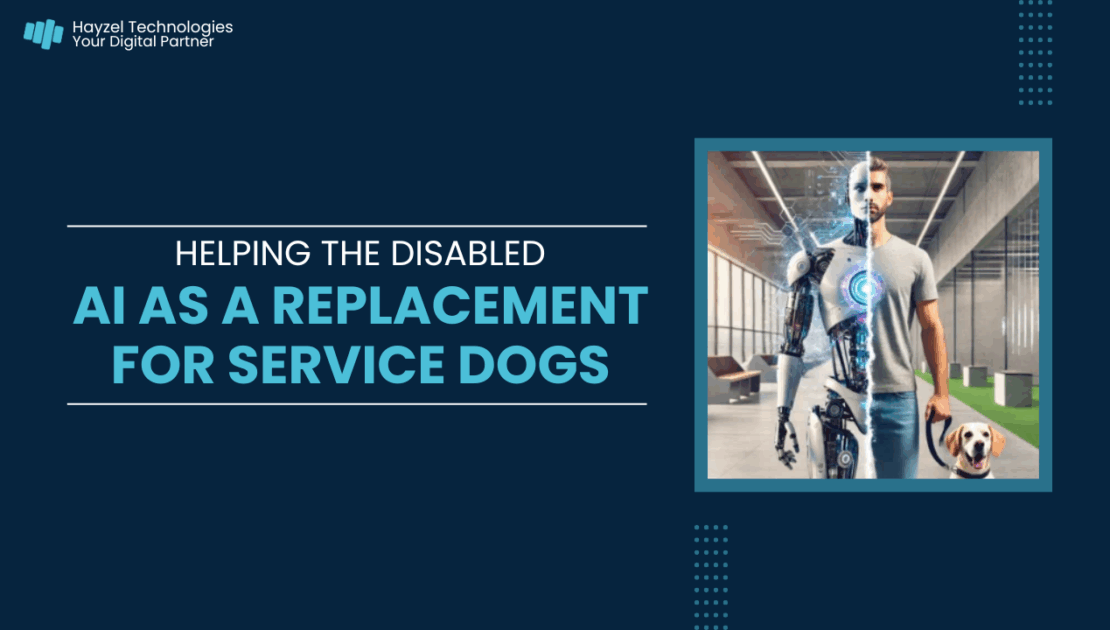
Helping the Disabled: AI as a Replacement for Service Dogs
By: Fahm Ali Sehgal – Communications Officer, Hayzel Technologies
Dogs are some of the most beautiful creations of nature. A creature so pure at heart, it is not afraid to express its affection and loyalty towards us. The famous author Mark Twain said, “The dog is a gentleman. I hope to go to his heaven, not man’s.” The dog’s loyalty coupled with its extraordinary intelligence makes it the excellent partner and companions for humans.
The Incredible Ways in which Dogs help Humans
Today, the most well known role of service dogs is guiding people who are blind or visually impaired. Dogs help them with navigating streets, avoiding obstacles, and finding doors, stairs, or seats. People with neurological disabilities such as Autism and mental health problems such as anxiety PTSD can also make use of guide and service dogs to help them. Dogs can help reduce anxiety for such people and also help with social interactions for people with autism. Seizure alert dogs can help people with Epilepsy by alerting the person right before the seizure is about to occur. Hearing dogs can help people who are deaf or hard of hearing by alerting the person when someone calls their name or rings a door bell.
| Disability | Type of Service Dog |
| Blindness | Guide Dog |
| Deaf/Hard of Hearing | Hearing Dog |
| Mobility Impairments | Mobility Assistance Dog |
| Autism | Autism Support Dog |
| PTSD/Anxiety/Depression | Psychiatric Service Dog |
| Epilepsy | Seizure Alert/ Response Dog |
| Dementia | Reminder/Companion Dog |
However, just like us, dogs are living creatures with a soul and they don’t come without their limitations. Just like any other dog, services dogs also have to be taken care of which can be difficult for people with disabilities. Other than that, service dogs are expensive, both to own and take care of. This is where AI steps in and aims to provide support to disabled people while solving all these problems.
Can AI help humans in ways that dogs do?
AI with all of its ongoing developments is quickly becoming a very powerful tool for the assistance of disabled people. For most of tasks currently being performed by service dogs, AI offers powerful solutions.
- Blind People
AI offers wearable devices that use camera vision to identify objects, signs and people. LiDAR and GPS systems can help map environments and guide users via voice instructions.
- Deaf People
People who are hard of hearing can make use of smart apps such as speech to text apps that convert voice commands into visuals.
- Mobility Impairments
People with mobility impairments can make use of voice controlled home systems that can turn on and off lights and appliances for them. Robotic arms can help perform tasks and fetch items for such people. Smart wheelchairs with AI navigation and LiDAR can help move such people around.
- PTSD/Anxiety/Depression
AI assisted chatbots carry the ability to talk to people suffering from anxiety and depression to help them feel better.
- Epilepsy
Wearable devices such as the Empatica’s Embrace Watch can detect early signs of an epileptic seizure to alert the user about it. Predictive AI analytics can be used to forecast seizures based on biometric data.
As incredible as AI is at solving these problems, it can never truly replace service dogs because AI can never have something that dogs have, a soul. The pure emotions of love, loyalty and care can never truly be replicated by AI. No matter how far AI may progress, service dogs will always hold a special place in our hearts.
